The Purchases We Make

In their book The Elephant in the Brain, Kevin Simler and Robin Hanson write about “conspicuous consumption,” a term coined by economist and sociologist Thorstein Veblen who lived about 100 years ago. Simler and Hanson write, “When consumers are asked why they bought an expensive watch or high-end handbag, they often cite material factors like comfort, aesthetics, and functionality. But Veblen argued that, in fact, the demand for luxury goods is driven largely by a social motive: flaunting one’s wealth.” The other pieces of the argument, the good performance of the item, the colors we were dying to have, and the durability of the product might be the true reason we made a purchase in some instances, and that allows us to make those excuses even though they only describe part of our behavior. A big part of Hanson and Simler’s book focuses on the idea that we use these types of excuses to justify our actions. Further, they argue that our behaviors often signal something about ourselves implicitly that we don’t want to say explicitly.


In the case of luxury goods the thing we are signaling is our wealth. Our wealth demonstrates our financial resources and can be used as a proxy for our social capital and human value. Our wealth may give others insights into our skills and abilities to do hard things, helping us stand out against a crowd. And, our wealth may reveal our deep social connections or our family’s high status, two social traits that certainly helped our ancestors pass their genes on in small political tribes.


The problem today, however, is that we don’t admit this is what we are doing with our purchases, and as a result we face major negative externalities from our consumptive habits. We spend a lot of money on unnecessary luxury goods, and many people go deeply into debt to signal that they are the type of person who would own a certain type of luxury good. Our unyielding desire in the United States for ever further and greater consumption leads us to buy larger houses that we have to heat, faster cars that use more energy, and to own more clothes that will take millions of years to break down thanks to the new synthetic fibers we use to make them. Our consumption and our drive to continuously signal our wealth and social value, some would argue, is poisoning and heating our planet to dangerous levels.


Simler and Hanson don’t focus on the externalities of our signaling behavior in their book, but they do acknowledge that they are there. The authors simply make an argument that most of us would rather ignore. That we do things for selfish motives and reasons we don’t want to talk about. This is important if you are an economics, sociology, or policy researcher because you need to understand what people are really doing when they rally politically or make economic decisions.  For the rest of us, in our daily lives, we can take a lesson from Hanson and Simler that stems from an awareness of our self-centered behavior. We can think about our signaling behaviors and ask if conspicuous consumption is really worthwhile. We can step back and ask if the ways we signal our wealth help or hurt the planet, and we can start to make decisions with positive externalities and attempt to avoid the negative externalities I mentioned above.

More on Hiding Our Motives

Deception is a big part of being a human being. If we try, we can all think of times when we have been deceived. Someone led us to believe one thing, and then we found out that something different was really going on the whole time. If we are honest with ourselves, we can also see that we clearly try to deceive others all the time. We make ourselves seem like we are one thing, but in many ways, we are not exactly what we present ourselves as being. Sometimes we truly are genuine, but often, we are signaling a particular behavior or trait to a group so that we can be accepted, praised, and get some sort of future benefit. In order to do this really well, we create stories and ideas about why we do the things we do, deceiving even ourselves in the process. As Kevin Simler and Robin Hanson wright in their book The Elephant in the Brain, “We hide some of our motives…in order to mislead others.”


This is not a pretty idea of humans, and expressing this idea is an admittance that we sometimes are not as great as we like to make everyone believe. This is not an idea that is popular or that everyone will be quick to admit, but I believe that Simler and Hanson are right in saying that it is a huge driving influencer of the world around us. I also don’t think that accepting this about ourselves ends up leaving us in as sad, cynical, and dejected of a place as one might think. Humans and our social groups are complicated, and sometimes being a little deceptive, doing things with ulterior motives at their base, and behaving in a way to signal group alliance or value can be a net positive. We can recognize that we do these things, that we are deceptive, and that we deceive others by lying about our motives, and still make a good impact in the world. The altruist who donates money to the Against Malaria foundation may tell himself and everyone he knows that he donates because he wants to save people’s lives, but truly he just gets a warm glow within himself, and that is perfectly fine as long as the externality from his status seeking behavior is overwhelmingly positive (looking in the mirror on this one).


If we don’t accept this reality about ourselves and others then we will spend a lot of time trying to work on the wrong problem and a lot of time being confused as to why our mental models of the world don’t seem to work out. In my own life, recognizing status seeking behavior, self-deception, and motivated thinking helps me to be less judgmental toward other people. I recognize that I have the same capacity for these negative and deceptive behaviors within myself, and I choose (as much as I can) to redirect these types of behaviors in directions that have the greatest positive social impact rather than in the direction that has the greatest personal benefit for me and my feelings. Ultimately, I encourage us to be honest about the fact that we are sometimes rather dishonest and to build our awareness in a way that is easy on ourselves and others for behaving as humans naturally behave, but still nudges us in a direction where we create positive externalities where possible from these ways of being.

Designed to Act on Hidden Motives

The human brain evolved in a social and political context. As our species developed, it mattered who you were close allies with, who you were opposed to, and who you cooperated with to survive. You needed to build up your social support to survive each day, but you also needed to build up your status so that your offspring and their offspring could survive and reproduce. Genetic survival and continuation of your genes and family depended on you being able to operate and survive in coordination with others in a world that didn’t have enough food, shelter, mates, and resources for everyone to survive all the time.


As our species expanded, our brains got bigger, took up more of our energy, made us smarter, and helped us further develop our social, political, tribal societies. In order to do well in these tribes, we had to be good at helping others in a way that furthered others’ trust in us and encouraged reciprocation. We had to appear to be helping others while at the heart of what we did, we wanted to ensure our survival and the survival of our children.


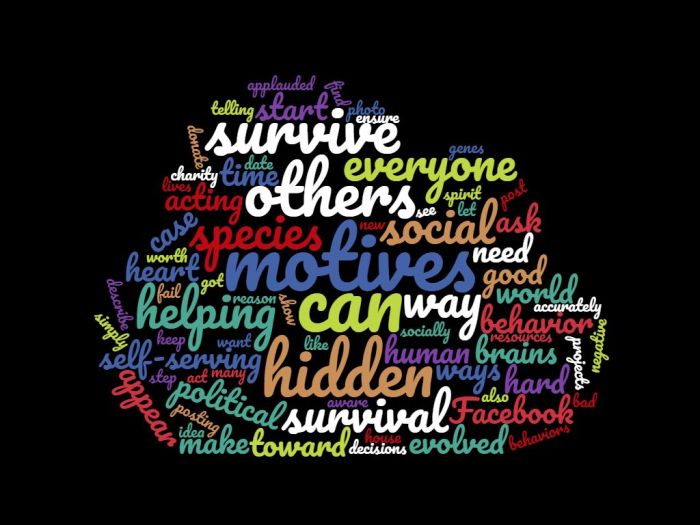
This idea is at the heart of The Elephant in the Brain by Kevin Simler and Robin Hanson. We evolved to be self-interested and self-serving, but in a deceptive way that is hard to notice. The authors write, “Here is the thesis we’ll be exploring in this book: We, human beings, are a species that’s not only capable of acting on hidden motives–we’re designed to do it. Our brains are built to act in our self-interest while at the same time trying hard not to appear selfish in front of other people.”


We hide our hidden motives from everyone, including ourselves, as we go about the world, but if we look closely, we can find the motives in ourselves and others that more accurately describe our decisions and behaviors. We post a photo on Facebook telling ourselves and others that we want to keep our friends up to date with our new house projects, but a more plausible reason for posting on Facebook is simply that we wanted to show off and be socially applauded. We like to donate to charity in the spirit of helping those who are in need, but we often fail to ask where we could make a donation to help the most people, and we are good at finding ways of making our donation very visible so that everyone knows what we donated.


These hidden motives are not all bad, but they do exist and in many ways drive our behavior. We need to be aware of our hidden motives and our capability of acting on them. When we are honest with ourselves about why we do what we do, we can start to have more agency in our lives and the choices we make. We can start to see that much of what we do is purely status seeking behavior, and we can ask ourselves if it is truly worth it or if we can step back and let go of our hidden motives on a case by case basis. We can shape policy in a way that redirects externatilities from our hidden motives toward positive outcomes rather than toward negative self-serving outcomes. We don’t have to evolve away from hidden motives to meaningfully engage with the world, but we should recognize them and do our best to prevent negative hidden motivations from driving our emotions, behaviors, and decisions.

Do What Is In Us

Lord of the Rings can be read as a reaction against the industrial age, a reaction against military might, and a reaction against colonial conquests. The most clean, well functioning, and happiest places in the book are places of nature, where hobbits live peacefully with plenty in the shire, and where elves live with wisdom and respect for trees, forests, rivers, and valleys. Tolkien seems to express the idea that we should live a bucolic life that is more connected with nature, tending to it to receive the gifts that nature gives us as opposed to laying down our black mastery of the planet and bending it to our will as we do with roads, railroads, dams, and the machinery of war.


In the story, Gandalf says, in a reaction to Sauron trying to rule everything, “Yet it is not our part to master all the tides of the world, but to do what is in us for the succor of those years wherein we are set, uprooting the evil in the fields that we know, so that those who live after may have clean earth to till. What weather they shall have is not ours to rule.”


Succor is defined, according to the dictionary in my Kindle, as “assistance and support in times of hardship and distress.” Gandalf says that we should live our lives in a way that sets the world up to be more successful and bountiful in the future. We should strive to remove bits of evil from the world, to constantly make small improvements or do our little part to make the world a better place. We should not do this just for ourselves and for our happiness, but so that future generations can inhabit a world that can still provide for their needs.


This message is important for me. We can set out to be the best, to always have more, to accumulate as much fame and notoriety as possible, and to rule the world with golden towers and green acres everywhere we go. Or, we can accept that the world is not ours, we can strive toward mastery of a few things without spreading ourselves too thin, and we can focus on our corner of the world and what is in our power right now to make the world a better place. This may look like picking up trash along our local street, it may look like calling our grandma, or it may look like smiling at that person smoking outside the Walmart and saying hi rather than giving them a contemptuous look and treating them like trash. We can strive to be great and to make lots of money and influence the world, but what really matters is if we take small steps daily in the ways we can to make the world better for the future, even if that means we inconvenience ourselves a little to do the good work.
Morning Counsels

Morning Counsels

I do almost all of my writing for this blog in the morning. For whatever reason, thinking clearly in the evening (at least clear enough for writing) feels impossible for me. Once I have gone through an entire day, once I have spent my mental capital at work, listened to podcasts, and had dozens of conversations with colleagues, friends, and family, my brain can’t quite focus and think about what it wants to say about a given topic in a coherent way. At a certain point at night, I am completely unable to string together clear and coherent thoughts. It is certainly not a time where I am going to have great insights, and probably not a great time for me to make big decisions.


Many, though certainly not all of us, share this type of pattern. There is something about sleeping and unplugging for several hours that allows us to return to our thoughts and ideas from the day or night before with more clarity. I have noticed many times that jumbled, cloudy thoughts seem more organized in the mornings, the connections between disparate pieces coming out more profoundly in the morning than at night. Decisions, and my resolve to commit to decisions, are much more clear in the mornings as well. What seemed like only binary choices become full of possibilities I had not recognized nor considered before, and making a choice to stick to is simpler when my brain has had less stuff to manage for a day.


In J.R.R. Tolkien’s book, The Lord of the Rings, King Theoden’s brain apparently works the same as mine. while traveling and preparing for a battle, Theoden reached a point where he recognized his weariness and need to rest before making a decision and planning for future clashes. He said, “In the morning counsels are best, and night changes many thoughts.” Sleeping and getting some rest helped him to think differently about what choices he had to make and about the things he had observed. The night helped him develop new perspectives and become more considerate and insightful.


The quote from The Lord of the Rings makes me think about all the times I have made decisions while camping or traveling late at night. The decisions are never good and I usually get tired of making nuanced decisions and just decide for the future to do whatever feels easiest in the moment. We should postpone decisions while camping or traveling when our minds are exhausted at the end of the day. Sometimes the best we can do is say, “we need to sleep now and we can make a final decision on this thing in the morning.” For me, that would have certainly saved myself and the people I was traveling with a lot of headaches and given us back a bit more time for sleep. We should be like King Theoden and recognize that we won’t be able to process nuances at night, so rather than endlessly stating challenges and obstacles to decisions that need to be made, we should do nothing, and sleep before we make a hasty decision.

Hatred Hurts Itself

In general, in most of our lives, we probably do not get yelled at by other people too often. We also probably don’t do that much yelling at other people either. I don’t have kids, so usually if there is something that I really want to yell about it happens when I am sitting alone in my car driving. When I do get so agitated while driving that I want to yell about some other driver bothering me, I try to consider whether the other driver even knows if I exist, whether they are aware that they are frustrating me, and whether they will ever remember that they slightly inconvenienced my drive enough to make me angry.


These thoughts about anger and yelling at people came back to mind while reading over a quote from J.R.R. Tolkien’s The Lord of the Rings. When Isengard fell and Saruman locked himself in his tower, Galdalf spoke to Pipen and said, “Strange are the turns of fortune! Often does hatred hurt itself!”


Being outraged often doesn’t lead to things we want. When we fly into a fit of rage, we usually don’t get people to do things that make us happy and fix the underlying thing that made us angry. When we hate people uncontrollably, we usually make things in our own lives just as bad as we make things in other people’s lives.


What anger and hatred do is reveal a weakness in ourselves. If I were to yell at someone while driving or try to insult someone, I would not be harming them, but really harming myself. I would be revealing that I am not a calm and collected person, but instead a hateful and angry jerk who has little self control and little ability to think of others. Hatred is meant to be outward and in some senses is intended to tear down another person, but instead it reveals a weakness in character that pulls us down and in our rage causes us to make poor decisions that harm ourselves more than others. Gandalf was spot on with his observations of an angry and bitter Saruman.

&nbsp

For more on outrage, check out an old post of mine about feeling superior by being outraged.

Evaluating What Really Matters

I really wish that the work week was not 40 hours long. I really believe we could be just as productive working 6 hour days rather than 8 hour days, and I think that we could use our extra time to build meaningful social capital in our societies and lives. (As an aside, I do recognize that a shorter work day would really just mean our cities would sprawl more and we would live further from work and spend more time commuting for work). Where we are right now, is in a weird position where we have allowed our work to consume almost all of what we do for reasons we don’t like. We work 8 hours a day and 40 hours a week because we want more and we want things that don’t really matter so that we can impress people we don’t really care about. We are focusing on things that are not that important and giving up large amounts of our lives to pursue these meaningless things.


In Letters From a Stoic, Seneca writes, “it is easy to escape, if only you will despise the rearwards of business. We are held back and kept from escaping by thoughts like these: What then? Shall I leave behind me these great prospects? Shall I depart at the very time of harvest? Shall I have no slaves at my side? No retinue for my litter? No crowd in my reception room?” It is hard to look at the opportunity for material gain and turn it down in favor of enjoying time. It is hard to draw back when we see an avenue for promotion, a way to work more to earn more, or a chance to gain more status and prestige. Often however, we hate the time we spend working and we put ourselves in situations that are dangerous to our health (even if you are not going into a mine, going into an office that spikes your blood pressure every day is unhealthy).


“Hence men leave such advantages as these with reluctance,” Seneca writes, “they love the reward of their hardships, but curse the hardships themselves.”


I recognize how important hard work is. I understand that without everyone working together to get stuff done, society does not advance, we don’t grow and prosper, and we don’t have any way to enjoy our leisure time. But I think we may be at a point where we are no longer working to enjoy our leisure time. We are not seeing our levels of work decline as we become more prosperous, we see the opposite. Productivity growth is slow, but the hours we spend working are increasing. This suggests we are putting ourselves in places we don’t want to be, not really working that hard when we are there (because we hate it) and then getting rewards we don’t even have time to be happy with.


I think we should step back and reconsider the things that really matter. We should find ways to pull back from work we hate and dislike. We should find ways to give people time and should encourage people to use that new time in a way that brings communities together with shared purposes and prospects. Rather than selfishly working for ourselves, we should spend more time engaged in a community and working together for others.

Wasting Ourselves on Work

I have some ideas about work that are pretty far out there for an American. In the United States, we prize work so highly that we put up with all kinds of BS in order to make more money, show our worth, and earn particular titles. It is true that we need to work and earn money to live comfortable lives, but the extent to which we chase money and status is far beyond what is really necessary for us to be comfortable and this pushes the work we do in strange ways. We elevate the importance of our careers and often judge ourselves and others first by the jobs we have. When we meet a new person, one of the first questions we ask is, “what do you do?” meaning, what is your job. We don’t ask what someone likes to do for fun, what hobbies someone has, or where someone last vacation. Instead we ask about their job so that we can compare ourselves to them and get a feel for the kind of person we are speaking to.


In Letters from a Stoic, Seneca writes, “A good man will not waste himself upon mean and discreditable work or be busy merely for the sake of being busy.” We are going to spend about 80,000 hours of our life working. The time we spend earning money can be time that we spend engaging with something just for the purpose of earning a living, but it can also be time we spend trying to make the world a better place. We can push for ever greater responsibility in our job, ever higher salaries, and more impressive titles, but we don’t need to. Seneca would argue that to the extent possible for each of us, we should try to do the most meaningful work with the time, skills, and abilities that each of us have. This can be a daunting and paralyzing thought today, which is unfortunate, but it is something that many of us can consider as we move forward.


At some point I think most of us set out to make a difference and to do something more on the noble side of work. However, we often settle into careers we don’t really like, work in settings and for bosses we don’t enjoy, and push ourselves in our careers at the expense of our family, happiness, time, and sometimes sanity. At a certain point, once we have a high enough salary, I think our goals and motivations shift from doing meaningful work and making enough for comfortable living to trying to impress others and show how valuable we are. This is equivalent of being busy for the sake of being busy, or worse, being busy for the purpose of impressing other people.


We won’t all have the ability to do the most meaningful work on earth, and I understand how scary it can be to step away from a good paying yet boring or meaningless career to take on something meaningful but low paying and unstable. I know that as our income rises our satisfaction with life will also rise, yet we should be considerate and aware of our trade-offs in search of more money, and we should be honest with ourselves about our motivations for the work we do. When we can, we should try to make a difference and do the best with our skills, time, and ability and avoid having a career or trying to climb a ladder just to show off to those around us.

Preparing for Challenges

In November of 2018 I wrote a post about planning for resiliency. Michael Bungay Stanier described the importance of planning for failure, looking ahead and anticipating obstacles, and thinking through the ways we could recover from a drastic blow to our plans. It is not easy, but preparing ourselves for hard times will make it more likely that we can successfully manage setbacks when they occur.


This idea seems pretty clear and while we all familiar with saving for a rainy day, there has been relatively little focus in our society on preparing ourselves for other non-financial hardships. Interestingly, the idea from Michael Bungay Stanier is not as new as I thought when I first encountered it. In Letters From a Stoic Seneca wrote, “It is precisely in times of immunity from care that the soul should toughen itself beforehand for occasions of greater stress, and it is while fortune is kind that it should fortify itself against her violence.”


Stoic philosophy advises us to take advantage of the times when things are going well so that we can ready ourselves for times when it all falls apart. Rather than simply relaxing and enjoying our comforts, stoicism suggests that we pause, evaluate what is truly needed to live a good life, and consider how we would move on if all our comforts were suddenly stripped from us. It asks us what could go wrong and forces us to think about how we would still move forward, a skill that is hard and gloomy, but has a lot of upside.


I don’t think we need to overwhelmingly focus on death, loss, and hardship. We can still enjoy our comforts and our pleasures, but at least once every day we should stop to consider what things we have, how we live our life, and what is truly important for us. By doing this, we can enjoy our hobbies, relationships, and comforts more fully. By recognizing that things could fall apart we can better appreciate what we have now. Additionally, seeing the potential obstacles before they arrive allows us to be better prepared to overcome them when we must rise to the occasion. We don’t have to be on guard at all moments nor do we need to constantly look over our shoulder for danger, but we should be prepared to work for what is important or move in the direction we want when something shows up to block our path. We will be more successful and sound if we have been considerate and acted accordingly along the way.

Roughing It

In Letters From a Stoic Seneca encourages us to avoid living a life that is motivated by material possessions. He encourages us to recognize times when we desire more and more comforts and pleasures in our lives and to remember that we will never be satisfied with our things, and will always desire more.


An unfortunate reality for us humans is that the things we want seem to give us less satisfaction over time. We become accustomed to the heated seats in our new car, the large TV becomes normal, and the new espresso machine gets old and we stop thinking about how happy we are to have freshly  brewed coffee each morning. The question becomes, how can we be content with what we have and avoid landing in a place where we are never happy and constantly need to buy more stuff as if attempting to fill a hole in our lives?


Seneca has some advice, “Set aside a certain number of days, during which you shall be content with the scantiest and cheapest fare, with coarse and rough dress, saying to yourself the while: “is this the condition that I feared?”” What Seneca advises is that we spend time going without any comforts. That we picture what total failure would look like in our lives, and live in that way for a short while to truly experience the loss of our comfort. In today’s world this may look like locking up our GPS watch and smartphone, wearing only our most junky tennis shoes for a few days, sleeping on the floor in the living room (as if we didn’t have a bed) with our oldest pillow and thinnest blanket, and eating just canned beans and rice for a few days.


Living with nothing for a short period of time may help us appreciate the things we take for granted in our lives. It also can help us see that all the comforts we rely on, that we were so excited to get at first and that we forget about over time, are not things that are essential to our survival. By remembering not to rely too heavily on these comforts, by seeing that we could live without them, and by roughing it for a little while, we can develop better relationships with our stuff.