The Spotlight Effect

The Spotlight Effect

We are social creatures that crave connections with and acceptance from other people. We want to have many allies as we move through life and want to be seen as a valuable ally to others. In our minds, we magnify our actions, words, and behaviors, examining what we do and how we present ourselves to others to make sure we are winning as many allies as possible. However, this constant focus on ourselves and how we might appear to others creates an illusion known as the spotlight effect. We are so focused on how we are presented to others that we begin to feel as though everyone else really is watching us and really is paying attention to how we present ourselves.


The reality, for most of us, is that very few people really notice much about us. Our spouse and other members of our household probably notice the little details about us, whether we haven’t shaved for three days, whether we have worn the same shirt two days in a row, and whether something is really bothering us, but most other people probably don’t notice that much. The reality is that most of them are focused on themselves, falling into their own spotlight effect and not actually paying much attention to what we are doing.


Richard Thaler and Cass Sunstein write about the spotlight effect in their book Nudge. They write, “One reason why people expend so much effort conforming to social norms and fashions is that they think that others are closely paying attention to what they are doing. … here’s a possibly comforting thought: they aren’t really paying as much attention to you as you think.”


People follow traditions, like wearing ties, that they dislike because they think everyone expects them to wear a tie and will be disappointed in them if they fail to wear one. This example of conformity bias mixed with the spotlight effect is relatively harmless, but the spotlight effect can have more severe consequences. People may believe their phones and social media posts are being watched by the police, they may worry that their colleagues will think of them as a cheapskate if their Secret Santa gift isn’t expensive and cool enough, and they may worry that other people on social media won’t find them authentic if they don’t angrily denounce the outrage of the day. These examples show how the spotlight effect can play into conspiratorial thinking, spending more money than one can really afford to spend, and engaging in signaling behaviors that might be beyond reasonable.


This is why Sunstein and Thaler’s quote can be helpful and possibly comforting. It is useful to recognize that we overanalyze ourselves and focus too highly on everything we do and how we present ourselves. Understanding this can help us see that everyone is so focused on themselves that they don’t have a lot of mental capacity left for scrutinizing everyone else. Once we realize that others are not paying as much attention to us as we thought, we can scale back negative aspects of conformity and self scrutiny. We can dial back the spotlight effect, and hopefully make decisions and choices that better fit the person we are, not the person we try to convince everyone else that we are. There are positive aspects to the spotlight effect, but for many of us, we probably over stress ourselves worrying about what others think, and would benefit from recognizing that others don’t pay so much attention to us.
The Happiness of the Moment

The Happiness of the Moment

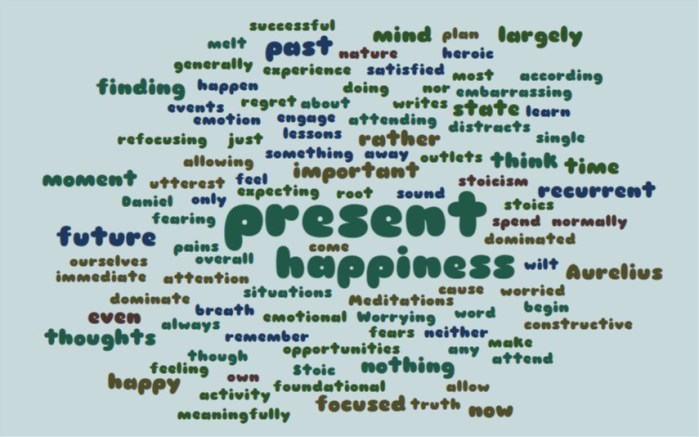
In Meditations, Marcus Aurelius writes, “remember that neither the future nor the past pains thee, but only the present.” He also writes, “if though holdest to this, expecting nothing, fearing nothing, but satisfied with thy present activity according to nature, and with heroic truth in every word and sound which though utterest, though wilt live happy.”


Aurelius is a foundational Stoic thinker. A key part of stoicism is remaining in the present moment, focused on where you are now, what you are doing now, and how you can best use your current time. Worrying about what will happen in the future and feeling regretful of what has happened in the past only distracts from the present moment, bringing anxiety to situations that on their own do not cause any negativity in our lives.


The stoics, it turns out, were largely correct about finding happiness in the present moment. Daniel Kahneman, in Thinking Fast and Slow, writes, “Our emotional state is largely determined y what we attend to, and we are normally focused on our current activity and immediate environment. There are exceptions, where the quality of subjective experience is dominated by recurrent thoughts rather than by the events of the moment.”


Happiness is generally an emotion we feel when we are present. By refocusing our mind on our present activity and finding constructive and useful outlets for our attention, we can find happiness, even if our past has been a nightmare or if we are afraid of what will come in the future. It is important to learn lessons from the past and important to plan for the future to be successful and maximize our opportunities to meaningfully engage in the world, but when we spend all our time allowing recurrent thoughts to dominate our mind, we will diminish our overall happiness. If we constantly think about something embarrassing from the past, if we are always worried about an upcoming deadline, or if we only think forward to vacations and what we would rather be doing, then we won’t be happy in the moment. We won’t make the most of our current situation, and we won’t be content where we are. By focusing on the present and attending to a single present task or activity (even if it is just our breath), then we can root ourselves to our current state, and allow the regret and fears from our past and future to begin to melt away.
Why Terrorism Works

Why Terrorism Works

In the wake of terrorism attacks, deadly shootings, or bizarre accidents I often find myself trying to talk down the threat and trying to act as if my daily life shouldn’t be changed. I live in Reno, NV, and my city has experienced school shootings while my state experienced the worst mass shooting in the United States, but I personally have never been close to any of these extreme yet rare events.  Nevertheless, despite efforts to talk down any risk, I do psychologically notice the fear that I feel following such events.


This fear is part of why terrorism works. Despite trying to rationally and logically talk myself through the post-terrorism incident and remind myself that I am in more danger on the freeway than I am near a school or at a concert, there is still some apprehension under the surface, no matter how cool I make myself look on the outside. In Thinking Fast and Slow, Daniel Kahneman examines why we behave this way following such attacks. Terrorism, he writes, “induces an availability cascade. An extremely vivid image of death and damage, constantly reinforced by media attention and frequent conversations becomes highly accessible, especially if it is associated with a specific situation.”


Availability is more powerful in our mind than statistics. If we know that a given event is incredibly rare, but have strong mental images of such an event, then we will overweight the likelihood of that event occurring again. The more easily an idea or possibility comes to mind, the more likely it will feel to us that it could happen again. On the other hand, if we have trouble recalling experiences or instances where rare outcomes did not happen, then we will discount the possibility that they could occur. Where terrorism succeeds is because it shifts deadly events from feeling as if they were impossible to making them easily accessible in the mind, and making them feel as though they could happen again at any time. If our brains were coldly rational, then terrorism wouldn’t work as well as it does. As it is, however, our brains respond to powerful mental images and memories, and the fluidity of those mental images and memories shapes what we expect and what we think is likely or possible.
The Value of Difficulties

The Value of Difficulties

“For our powers can never inspire in us implicit faith in ourselves except when many difficulties have confronted us on this side and on that, and have occasionally even come to close quarters with us,” writes Seneca in Letters from a Stoic.


In the quote above, Seneca writes that we can never develop a legitimate sense of self-confidence if we never face difficulties and challenges. If our lives are free from real obstacles and if we never face any real struggles, then we will never be prepared to step up  to take on greater challenges. Growth and preparation for large and important moments in life comes from the struggles we wish we could have avoided along the way.


Seneca continues, “It is only in this way that the true spirit can be tested – the spirit that will never consent to come under the jurisdiction of things external to ourselves.”


By learning from mistakes, overcoming obstacles, and finding strength during difficult times, we begin to be able to step back and become more objective in how we view ourselves and the situations in which we find ourselves. Wild successes and crushing failures lose their influence on our lives when we have faced difficulties and survived. Instead of placing all our happiness in a certain outcome, instead of living with constant fear of something negative, we are able to be more calm and centered, accepting that things may not go well, but confident that we can make it to the other side in a reasonable manner if things don’t go well. In this way external pressures and outside considerations of our lives cease to have influence over how we live and how we feel from moment to moment. Only by facing obstacles, learning about ourselves, and surviving difficulties can we develop the mental fortitude to reach this level of self-confidence.
Violence and the Drug War

Violence as a Reason to End the Drug War

My last post was about violence related to drugs. When we make drugs illegal, we open the door for a black market. The best way to control a black market is through force and violence. A direct result of drug prohibition is violence related to black markets. We saw this in the United States with alcohol prohibition and in the 1970’s as the drug war in the United States escalated.


In Chasing the Scream Johann Hari writes, “By the mid 1980’s, the Nobel Prize-winning economist and right-wing icon Milton Friedman calculated that it [drug prohibition] caused an additional ten thousand murders a year in the United States. That’s the equivalent of more than three 9/11’s ever single year. Professor Miron [Jeffrey Miron, Harvard University] argues this is an underestimate. Take the drug trade away from criminals, he calculates, and it would reduce the homicide rate in the United States by between 25 and 75 percent.”


What Hari is doing in this quote is turning around the justification for a drug war and using it as a justification for ending the drug war. The typical argument that someone would make would be along the lines that drugs cause crime, so drugs should be illegal. Hari instead writes that drug prohibition causes crime, so drugs should be legalized.


The first option is instinctual and popular. Hari’s opinion is counter-intuitive, and would be a tough political sell. Nevertheless, I think Hari is correct.


I think it would be terrible to have huge numbers of people using recreational drugs during all their free time. I worry about the economic losses our country would face as people chose to do more drugs, harming their brains and bodies. These considerations make me fearful of finding legal ways to provide safe drugs to people.


However, that perspective doesn’t consider the costs that are in our current status quo. The current drug prohibition creates criminals and black market drug dealers. It gives gangs a profit source, and leads to young people choosing gangs over legal ways to make money, and in the process, still destroys the lives of huge numbers of people. Perhaps a legal system would reduce our deaths, and maybe even if drug use picks up, the overall number of people dying and losing opportunity to meaningfully contribute in this world would decrease. We wouldn’t have as much gang violence, wouldn’t arrest so many young black men, wouldn’t have so many people die from using unsafe drugs. Hari argues this trade-off will pay off, and I think he might be right.
Fears and Symbols

Fears and Symbols

“Its a natural human instinct to turn our fears into symbols, and destroy the symbols, in the hope that it will destroy the fear,” writes Johann Hari in his book Chasing the Scream. Hari writes this to explain the ways in which American culture has responded to drug use and addiction. We have demonized drugs and cast out drug addicts as moral failures. Our mindset is that the eradication of drugs and the expulsion of addictions will solve many of our countries ailments. If only there were not dangerous tempting chemicals to hook our brains, and if only people were more strong to resist the temptations to use use drugs, we could all be happy, productive, and united again.


In reality, drug use and societal ailments are more complicated than this paradise lost narrative. Hari’s quote continues, “It is a logic that keeps recurring throughout human history, from the Crusades to the witch-hunts to the present day. It’s hard to sit with a complex problem, such as the human urge to get intoxicated, and accept that it will always be with us, and will always cause some problems (as well as some pleasures). It is much more appealing to be told a different message – that it can be ended. That all these problems can be over, if only we listen, and follow.”


I think it is really interesting that we have such a tendency to turn our fears into symbols. We take the things we are afraid of, the things that disgust us, and create symbols to represent that evilness and reprehensible aspect of the world. The symbol could be a president you dislike, a foreign religion or character, chemical substances, or personality traits (laziness, close-mindedness, selfishness). This gives us a heuristic for addressing the thing we don’t like. It creates a less complicated version of the thing we fear, and allows us to draw a moral line in the sand, separating us (the good ones) from them (the bad ones associated with the evil symbol).


As Hari’s quote reveals, these symbols, and our efforts to destroy these symbols, can be problematic themselves. The Crusades were costly wars waged on outsiders, witch-hunts wrap up innocent people and threaten lives, and political polarization fueled by the hate of one political party or candidate only increases the gulf between us and our fellow citizens and human beings. Fears and symbols might be useful for galvanizing action, but they can have a wide range of negative externalities, and they can be misunderstood and over-generalized. Additionally, our fears and symbols can be captured by actors and institutions which seek to further their own ends, deliberately harming others in pursuit of their own agendas.


I don’t think Hari would tell us to abandon all of our symbols for our fears. He might agree with me that it is likely impossible to do so. The alternative seems to be to recognize when you are using such symbols and to understand how you are reacting to them. Are you allowing a symbol to stand for something you will avoid in your own life, or are you allowing a symbol to stand as a marker of your own righteousness? If you are using fears and symbols for self-control and discipline, you might be ok, but if you are using them simply to judge others and to justify avoiding or out-casting them in an effort to signal your virtue to others, you may be more of a problem than you realize. When these symbols and our efforts to destroy them start to harm others, we have a problem and need to redirect our energy to find real solutions to the real problems that underlie the fears and symbols in our lives.

On Forms of Status – Dominance

In The Elephant in the Brain authors Kevin Simler and Robin Hanson write about our hardwired desires to increase our status. No matter who we are, where we are, or what we are doing, we are subconsciously aware of our status and we are pretty much always trying to increase our status one way or another. The authors describe two type of status, and how our attempts to increase our status change depending on the form of status we seek. They write,


“Status comes in two distinct varieties: dominance and prestige. Dominance is the kind of status we get from being able to intimidate others – think Vladimir Putin or Kim Jong-un. Dominance is won by force, through aggression and punishment. In the presence of a dominant person, our behavior is governed by avoidance instincts: fear, submission, and appeasement.”


Tomorrow I will continue their quote and write about prestige, but for now, I’ll share a few thoughts that I have on dominance. Dominance as a strategy for obtaining strategy to me feels more primitive, and while it may be the kind of status we often seek in sports, courts, and boardrooms, it is not the kind of status that usually seems to be the most effective. In a politicized world where many weaker individuals can gang up on the stronger more dominant individual, this path can be a dangerous route to take. In other parts of the book Simler and Hanson seem to argue that our brains evolved to be more successful in seeking status in other ways.


People who seek greater status through dominance alienate a lot of people. They may be impressive in their abilities to bulldoze through their competition and they may achieve great success, but in the social and political species that we are, having friends and allies is important. Dominance does not encourage greater cooperation among talented individuals, but instead seems to force away those who are less dominant. It is not hard to see how this could lead to a small number of dominant sycophants sticking together to ward off attackers, and it is also easy to see how this strategy could backfire and fail to produce long-term status.


Ultimately, seeking status and seeking dominance seems to be a “careful what you wish for” type of approach. When your status is based in your dominance of other people, you can never be successful or attain a sense of success on your own. Our status is always tied to others by nature of being relative, but the dominance approach leaves you vulnerable to every slight. Achieving great status in this way is likely to leave you in a point where your status is high in only select groups, and despised in others.

Be Calm Ahead of Your Obstacle

In Letters From a Stoic Seneca writes, “There are more things … likely to frighten us than there are to crush us; we suffer more often in imagination than in reality.” Our minds work really hard to keep us safe, keep us in important positions, and keep us connected so that we can succeed and so that our children and grandchildren can enjoy a high status life. Our minds are trying to help us navigate an uncertain future, but sometimes our minds go too far and we become paralyzed with a fear that is worse than the outcome we want to avoid.


Seneca continues, “What I advice you to do is not to be unhappy before the crisis comes; since it may be that the dangers before which you paled as if they were threatening you, will never come upon you; they certainly have not come yet.”


We can live our lives worrying about what will go wrong five minutes from now, five days from now, or five years from now, but we never truly know what is around the corner. Sometimes we set artificial deadlines on ourselves and sometimes those deadlines are forced upon us, but that doesn’t mean we need to live every moment of our lives up to that deadline in fear of what will happen if we don’t achieve what we intended by that date. The fear that we feel can be useful in pushing us to get stuff done and avoid procrastination, but when we notice that we can’t sleep at night because we are worried of the negative consequences of what may happen if that bad thing we fear occurs, then it is time for us to step back and refocus on our present moment. I find that it is helpful for me to look at the fears that I have and recognize that in the present moment I am fine, and to recognize that the status quo will most likely continue if I miss the deadline or if the bad thing does happen. There are plenty of things to fear, and we should build a capacity to see that we will still be able to move on with life even if some of our worst fears come true.


Ultimately, we know we are going to have obstacles and setbacks in our lives, but that does not mean we need to live every moment in fear of what bad thing is around the corner. We can live conservatively and save money and resources to confidently weather such challenges, but we do not need to allow negative things in our lives to cause us trauma before they have occurred. Preparing ourselves ahead of time will help mitigate the fear, but learning to accept that bad things will happen and learning to enjoy the present moment are the only ways we can truly escape from the fear of what lies ahead.

The Torment of the Past and Future

Our brains and the way we think about the world are basically our real world super power. We are able to predict what is going to happen five minutes from now, five hours from now, and five days from now. We can remember loads of information from our past and synthesize that information in new situations to draw new conclusions. We are able to intuitively recognize what other people are thinking and to deduce how they felt in past situations or how they will feel in future situations. Our brains do incredible work to help us move through the universe and our species would not be here today without our brains’ super powers.


But as great as these super powers are, they can also lead us astray and cause real problems in our lives. Ruminating on things we do not like from our past or on our fears for the  future can be life ruining. We can become embarrassed, scarred, and find ourselves in so much pain from our past that we cannot enjoy our present. Similarly, we can become paralyzed with fear, disillusioned with possibilities, and stuck thinking about negative things may happen in the future, causing us to forget our present moment. In Letters from a Stoic Seneca writes, “But the chief cause of both of these ills is that we do not adapt ourselves to the present, but send our thoughts a long way ahead. And so foresight, the noblest blessings of the human race, becomes perverted. Beasts avoid the dangers which they see, and when they have escaped them are free from care; but we men torment ourselves of that which is to come as well as over that which is past.”


To a much greater extent than many of us do, we should probably seek out psychological services to help us better order our thoughts. Stoicism has helped me with remembering the present and has given me tools to use to avoid ruminating on the future or past. Combining psychological services with a stoic toolkit can be very helpful in a world where happiness is presented in a way that doesn’t actually reflect the things that will make us happy. We want to plan ahead and strive for a healthy life where our needs are provided for, but if we become so focused on needing out life to have a particular type of car, or so focused on what might happen if we are not able to pay certain bills, then we can ruin our health and our current lives. And if we cannot let go of the past, if we cannot look at what has happened in our life and say, “that sucked, but here is what I can learn moving forward,” then we will constantly be haunted by ghosts. Learning to be present is not just about breathing exercises and comfortable pillows. Being present is about recognizing when our minds have jumped ahead or when our minds are stuck in the past and learning to refocus the mind on the current moment, the only time where we can take any action to improve things.

Longing for Impossible Things

I currently have Fernando Pessoa’s book The Book of Disquiet (translated by Margaret Jull Costa) on my headboard for a little bit of reading before bed. The book was not published during Pessoa’s lifetime, but was compiled and published after his death. It is a collection of Pessoa’s inner thoughts existing as diary entries, reflections on his life, disjointed feelings, and a set of observations about the world. The book includes incredibly written and translated passages like the following:


“The most painful feelings, the most piercing emotions are also the most absurd ones – the longing for impossible things precisely because they are impossible, the nostalgia for what never was, the desire for what might have been, one’s bitterness that one is not someone else, or one’s dissatisfaction with the very existence of the world.”


Pessoa is incredibly honest with himself through his writing and he seems to be able to interrogate every emotion and every thought he has. He is so good at it that it painfully tears him apart as he is unable to distinguish between himself, the natural world, the stories he creates of how it all ties together, and his unending awareness of everything inside and outside of himself.


His quote above stands out to me because I find such incredible inspiration and power in dreaming of large and almost unattainable things. At the same time, giant and ambitious goals terrify me, and leave me almost paralyzed, too afraid to take action but afraid not to dream. I constantly dream of things could have been different, of the steps and actions I could have taken to truly be on a path toward the greatness I desire, and dissatisfaction seems to lurk around every corner if I look for it. But like Pessoa, I recognize how vain and fruitless this way of thinking can be. There is a fine balance in life between believing in the potential of the future, and being paralyzed between the danger, fear, and monotony of every day life. Understanding how absurd our thinking is and recognizing the fallacies of our stories seems like a way to navigate between our ambitious goals and our defeating self doubt.


Greater awareness of who we are and the stories we tell ourselves can help us understand if our goals meaningful enough to make great sacrifices for. Recognizing how our narrative drives us gives us the ability to push back against our self doubt and allows us to craft a new framework that is not as limiting for who we are and who we want to be. We can even get outside the story of our goals and see what small actions we can take to begin to make progress toward our goals, defeating the paralysis we may feel. The recognition of the power of our inner narrative is the one thing that Pessoa seemed to be missing, and it also seems like the one thing that could have helped to change his fear and paralysis.