Incentives for Overestimating Risk

Incentives for Overestimating Risk

In the United States, and really across the globe, things are becoming more expensive. The price of food, gasoline, cars, and other goods have gone up quite a bit in the last year as the global economy adjusts to the new realities of the post-COVID world, as economies continue to respond to economic stimulus events, and as uncertainty around whether the pandemic truly is in our rear-view mirror continue to hang over our global consciousnesses. During this time of high inflation, many tv pundits, politicians, and experts are forecasting doom and gloom for national and global economies. Forecasting bad news seems to be the norm right now.
 
 
Steven Pinker explored the incentives for overestimating risk and forecasting bad news in his 2011 book The Better Angels of Our Nature. Pinker specifically looked at violence and war in his book and found that there are incentives for people to predict something negative, but not necessarily incentives for people to predict something positive. Pinker writes:
 
 
“Like television weather forecasters, the pundits, politicians, and terrorism specialists have every incentive to emphasize the worst-case scenario. It is undoubtedly wise to scare governments into taking extra measures to lock down weapons and fissile material and to monitor and infiltrate groups that might be tempted to acquire them. Overestimating the risk, then, is safer than underestimating it – though only up to a point. (emphasis mine)
 
 
We might be safer if everyone predicts a worst case scenario. If the people with the largest platforms focus on the dangerous potential for a terrorist attack, the public will demand action to reduce the risk. If there is a great focus on the need for improved safety equipment in hospitals responding to a new strain of COVID, then public officials are more likely to act. If there is overwhelming concern about inflation and economic collapse, the government will hopefully take better actions to balance the economy. Predicting that everything will work out and hum along on its own could be more dangerous than predicting the worst outcomes. Predicting doom and gloom not only gets attention, it can drive early and decisive decision making.
 
 
But as Pinker notes, it is safer to overestimate risk only to a point. Pinker cites the costs of the war in Iraq in search of weapons of mass destruction that did not exist as an example of dangerous worst case forecasting. Overreacting to COVID in China through excessive lockdowns and insufficient vaccination efforts may be contributing to higher global prices for goods at the moment. And predicting an economic collapse could spook markets and scare consumers, leading to worse economic outcomes than might otherwise occur. There are incentives to predicting the worst, but also costs if our predictions go too far.
 
 
I think our jobs as individuals is to be aware of the worst case scenarios, but not to become too trapped by such predictions. We need to remember that making worst case scenario predictions will provide feedback into what is already a noisy system. It is likely that forecasting the worst and spurring action by individuals will avert the worst. This doesn’t mean we can sit back and let others handle everything, but it should encourage us to think deeply about worse cases, our actions, and how panicked we should be.
Terrorist Motivations

Terrorist Motivations

One of the arguments that Robin Hanson and Kevin Simler make in their book, The Elephant in the Brain, is that we are not very good at accurately gauging the motivational reasons behind the actions of ourselves and others. We tend to look for large ideological and rational explanations for our behavior and the behavior of others. We often overlook simpler explanations of self-interest in favor of more high minded reasons for behavior.
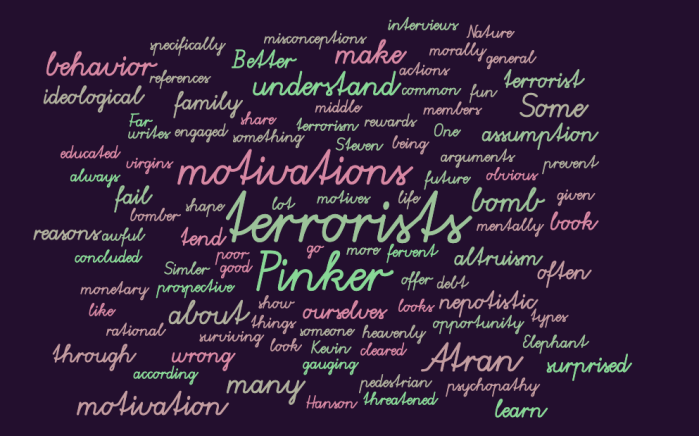
If we recognize that we do a poor job of understanding the motivation of ourselves and others, then it is not surprising to learn that our assumptions of terrorist motivations are also often wrong. Steven Pinker demonstrates this in his book The Better Angels of Our Nature. Pinker specifically looks at suicide bomb terrorists and our general assumption that they are motivated by pure religious beliefs. This assumption, according to Pinker, is incomplete for many suicide bomb terrorists. Pinker writes,
“Using interviews with failed and prospective suicide terrorists, the anthropologist Scott Atran has refuted many common misconceptions about them. Far from being ignorant, impoverished, nihilistic, or mentally ill, suicide terrorists tend to be educated, middle class, morally engaged, and free of obvious psychopathy. Atran concluded that many of the motives may be found in nepotistic altruism.”
Pinker shows that there are a lot of pedestrian motivations for why individuals become suicide terrorists. Their motivation is not always a fervent ideological belief or hope for a spiritual reward of heavenly virgins. Pinker references Atran to show that some suicide terrorists are given the opportunity to have their debt cleared for future generations by going through with a suicide operation. Some suicide terrorists have had families kidnapped and threatened if the suicide bomber doesn’t go through with a bombing. Some terrorist groups offer substantial money to the surviving family members of the suicide terrorists. These monetary and family life motivations are what Atran refers to as nepotistic altruism.
We frequently make assumptions about others and about what motivates them. We make fun of others based on our assumptions, dismiss them, and are surprised to learn that our assumptions can be wrong. We are surprised when we see someone do something awful for motivations that we share with them. When we fail to understand motivation, we fail to understand what types of policies, rewards, and punishments might be useful in changing behaviors. It is important that we accept that we don’t fully understand the motivations of others and work to improve our perspectives so that we can better shape society to prevent things like suicide bomb terrorism.
Why We Help Our Kin

Why We Help Our Kin

It is not a completely unreasonable question to ask why humans and other species go out of their way to help their kin. Whether it is our direct offspring, our nieces and nephews, our grandchildren, or other distant blood relative decedents, we often find a need to do things to help them. Despite how gross changing a diaper can be, how expensive helping someone get to college can be, or how costly the provision of aid and assistance can be, we find an inner pull to be of assistance. That inner pull is also often joined with outer social norms and expectations around kin assistance, despite the fact that sometimes the costs truly are burdensome.
 
 
Steven Pinker addresses this in The Better Angels of Our Nature. He writes, “natural selection favors any genes that incline and organism toward making a sacrifice that helps a blood relative, as long as the benefit to the relative, discounted by the degree of relatedness, exceeds the cost  to the organism. The reason is that the genes would be helping copies of themselves inside the bodies of those relatives and would have a long-term advantage over their narrowly selfish alternatives.”
 
 
If there is a chance that our genes are shared with another blood relative, then it makes sense that we would have an inclination to provide assistance to help that relative survive and pass along their genes. If the cost is not so great that we won’t be able to survive and pass along our genes, or ensure that a child who shares more of our genes won’t be able to reproduce, then we will provide assistance. From an evolutionary psychology standpoint, this theory aligns with observations and self-interest for individual humans and animals. Without pulling out a pen and paper or calculator, our brains are able to do a rough calculation of the cost we would face relative to the improved chance for survival of our kin. Where we see the needle inch toward the benefit outweighing the cost, we make an effort to help our kin, and put up with sometimes substantial individual costs. 
 
Two Genocide Non-Factors

Two Genocide Non-Factors

In his book The Better Angels of Our Nature, Steven Pinker examines evidence around numerous factors that contribute to violence or that we might expect would contribute to violence. In one section, he specifically looks at factors that do and do not contribute to genocidal violence. Better understanding what does and doesn’t cause violence can help us better understand how we should organize societies. And when we think about how we should organize societies and think about global populations given global poverty and ethnic diversity, the results that Pinker highlights regarding genocide can help us learn a lot.
 
 
“Measures of ethnic diversity didn’t matter, refuting the conventional wisdom that genocides represent he eruption of ancient hatreds that inevitably explode when ethnic groups live side by side,” Pinker writes. Genocide is hard to understand and ideas of natural ethnic group hatred and conflict seems like it must be a contributing factor to genocide. However, evidence indicates that across the globe many ethnic groups live side by side, without one side trying to completely eliminate the other. Either increased or decreased ethnic diversity relative to the global average isn’t what seems to be a sparking factor in whether genocide occurs, despite what we might assume.
 
 
“Poor countries are more likely to have political crises…” Pinker continues, “but among countries that did have crises, the poorer ones were no more likely to sink into actual genocide.” The second non-factor that Pinker highlights with regard to genocide is poverty. Economic development is also not a leading factor that determines whether a genocide will occur in a country or within a violent conflict.
 
 
These two factors are important to recognize as non-factors for genocide because both factors can be used to further harmful political goals. Claiming that ethnic diversity can lead to genocide might be used as a reason to restrict immigration and the movement of people across borders and regions. Some may claim that they are trying to prevent genocide by reducing the freedom with which some minority groups may be able to move. For the second non-factor, we can also see that poor countries are not inevitably inclined toward genocide as they try to increase economic wellbeing. We can dismiss poor countries and aid to poor countries relatively easily, especially in the United States if the poor countries are far away from us. Associating poorness with genocide may be a reason for some people not to support global aid and assistance, fearing that aid may be captured by a powerful ethnic group and used to wage genocidal violence against others. Showing that levels of poorness are not associated with genocide may be helpful in encouraging people to support global aid to poor countries.
Middleman Minorities & Discrimination

Middleman Minorities & Discrimination

Older interpretations of Christianity held that it was against the Christian God’s commandments for Christians to loan money and charge interest. Consequentially, across Europe Christians generally were not bankers, because it was a religious violation for Christians to be in positions where they were charging interest. Banking then became a niche role for non-Christians – Jews in particular across Europe. For hundreds of years Christians did not work as bankers, but Jews did, and today we still have the stereotypical consequences of the ancient traditions that kept Christians out of banking while opening up a spot for Jews within financial industries.
 
 
Steven Pinker writes about phenomena like the Jewish-Christian banking arrangement in Europe and the subsequent discrimination that Jews faced in his book The Better Angels of Our Nature. Pinker writes, “it’s common for particular ethnic groups to specialize in the middleman niche and to move to whatever communities currently lack them, where they tend to become prosperous minorities – and targets of envy and resentment.” Jewish banking is a salient and easy to understand example. Bankers are still hated today because they are not doing anything that really appears to be work to people who produce goods and don’t work in the banking industry. Bankers move money around and profit on capital, rents, and interest. Providing the capital for a project is important and valuable, but we have trouble understanding it and don’t easily trust those who are in such a position.
 
 
Pinker continues on this specific point, “in intuitive economics, farmers and craftsmen produce palpable items of value. Merchants and other middlemen, who skim off a profit as they pass goods along without causing new stuff to come into being, are seen as parasites, despite the value they create by enabling transactions between producers and consumers.”
 
 
Pinker gives other examples in his book of populations that have emigrated to new countries or existed within larger majority populations and found niche roles as middlemen. For the reasons noted in the quotes above, these minority groups have often found themselves scorned by the larger populations they find themselves within. They often become the victims of violence and have been the targets of genocide. Despite the fact that minorities (especially when they emigrate) find ways to fill important niches and despite the fact that filling such niches provides economic value, xenophobic populations can massacre minorities when rhetoric against them reaches irrational frenzies.
Former Agrarian Paradise & Urban Decadence

Former Agrarian Paradise & Urban Decadence

Modern humanity tends to look back at the past and see it as better than it used to be. We remember a time in the past where things were simpler, where people were nicer, and where people lived better than they do today. There are several cognitive illusions which play into this misperception of the past, and it can lead us to make bad judgments about the present and poor decisions about how we and others should live. This misperception of the past is partly due to the fact that as children and  teenagers we lived in a world where someone else was responsible for providing for our needs. It is partly due to the fact that our brains don’t remember the negative aspects of past experiences as much as the positive aspects of the past. The reality of childhood combined with cognitive errors is what gives us political movements that denounce modernity in favor of a past that never truly existed.
 
 
Steven Pinker references historian Ben Kiernan when he writes about this in his book The Better Angels of Our Nature. He writes, “time and again [utopian ideologies] hark back to a vanished agrarian paradise, which they seek to restore as a healthful substitute for prevailing urban decadence.” When we think about utopian human societies, we don’t always project forward as much as we project backwards. We picture a semi nomadic and agrarian life, but with much better tools and technology. Urban living is decadent, as in declining and decaying. We don’t see humanity flourishing in modern urban environments, which could be a problem for how we approach modern living.
 
 
Tyler Cowen often argues that we should be leaning into big business, technological development, and economic prosperity more than we do. Advances in living standards, improved vaccines and pharmaceuticals, and better technology are what allow us to live longer, healthier, and more fulfilling lives, Cowen often argues. We should be projecting utopian views that enhance economic and commercial activities, not utopian views that shun them. Unfortunately, however, when we think about human urban living and economics, we see something negative in ourselves and our futures. Pinker continues, “commercial activities, which tend to be concentrated in cities, can themselves be triggers of moralistic hatred.”
 
 
Transactional capitalism is somehow seen as one of the negative elements of our urban decadence. Most people don’t seem to view it as Pinker does, as a pacifying force that unites people unlike any other force in the world. People don’t see economic and commercial activities the way Cowen sees them either, as forces that drive the flourishing of humanity and humanity’s potential. We look back with longing on agrarian paradises that no longer exist, without recognizing the cognitive errors which give rise to the false views of our former societies. We remember the past as being better than it was, and only see decadence around us when we should be seeing the improved living standards, the protection from diseases, and the more exciting and entertaining lives that urban living and economic advancement have given us.
Categories are Approximations

Categories Are Approximations

My last post was on the human tendency to put things into categories and how that can cause problems when things don’t fit nicely into the categories we have created. We like to define and group things based on shared characteristics, but those characteristics can have undefined edge cases. This isn’t a big deal when we are classifying types of mushrooms or shoes, but it can be a problem when we are classifying people and when we extend particular qualities of a group of people to everyone perceived as part of that group.
 
 
This post takes the danger in that idea a step further. In The Better Angels of Our Nature, Steven Pinker writes, “people tend to moralize their categories, assigning praiseworthy traits to their allies and condemnable ones to their enemies.” We create groups and view them as binaries. If we step back, we realize this doesn’t make sense when evaluating people, but nevertheless, we do it. We view an entire group of people as good or bad based on how we categorize them and based on a few salient traits of the category.
 
 
Pinker continues, “people tend to essentialize groups. As children, they tell experimenters that a baby whose parents have been switched at birth will speak the language of her biological rather than her adoptive parents.” When we get older we realize this is not the case, but it hints at a general disposition that humans have. We don’t focus highly on environment and contextual factors for people. We assume that essential characteristics of the group they belong to, whether or not those characteristics are actually valid, apply to every member, even if members are separated from the group and placed in a new context.
 
 
Categorizing people can end up with us placing people in a specific frame of reference that denies their individuality and humanity. We see people as inherently geared toward certain dispositions, simply because they share characteristics with other people we assume to have such dispositions. From this categorizing and these harmful tendencies follow xenophobia and racism. We wish to be seen as an individual ourselves, but we put others into categories and judge them to be inherently good or bad. We assume good people are all like us, and that all people like us are bad. Conversely, we assume all people unlike us are in some way bad, or that all bad people are unlike us. This oversimplified thought process fuels polarization and a host of negative thinking shortcuts that we have to overcome to live in a peaceful, equitable, and cooperative society.
Categorization & People

Categorization & People

Human beings really like to categorize things. We categorize coffee brews, nuts and bolts, cars, plants, berries, galaxies, and even other people. Doing so helps us think about an incredibly complex world and helps us make better decisions. I know what kind of coffee I like for which methods of making coffee, so I can simplify my decision process to get a good cup when I am at a new coffee shop. Sorting nuts and bolts allows us to find the perfect fastener for each and every situation, meaning we can ultimately make more complex cars and trucks that fit the specific category we need for our purposes. And when we are looking to make a pie, knowing a little bit about different categories of berries helps us make a delicious pie. Categorization is essential for human survival, recreation, and scientific advancement. It is an exceptional tool for humanity.
 
 
But categorization can also be troublesome, especially when we start trying to categorize things that don’t seem to want to fit within our pre-defined categories. Nuts and bolts can be manufactured specific to our predefined categories, but not everything fits nicely into the categories we adopt and use every day. Nature’s creations, as well as man’s creations, can blend across multiple categories. Some plants, animals, seeds, fruits, geological formations, and clouds can all be very distinct and easy to categorize. A mountain is very different from a valley which is very different from the ocean. But All of these items can have fuzzy distinctions and can overlap in complex ways. 
 
 
This is often the case with people. As Steven Pinker writes in his book The Better Angels of Our Nature, “the problem with categorization is that it often goes beyond the statistics. For one thing, when people are pressured, distracted, or in an emotional state, they forget that a category is an approximation and act as if a stereotype applies to every last man, woman, and child.” Pinker is describing the consequences of using a simplifying process that doesn’t fit everything we want to put in the category. Humans rarely fit perfectly within the categories we create, and there can be bad consequences when we act as if they do. On top of bad categorization, we also forget that the categories we put people into don’t always matter very much. When we forget these things, we can treat people poorly and make poor judgments about the categories we have placed people into. This takes what is a useful tool of humanity and turns it into a dangerous shortcut that can cause serious harm for real life people.
The Importance of Knowing Trends in Violence

The Importance of Knowing Trends in Violence

Most people are generally not aware that the world is becoming a more peaceful place. Stories about things that are slowly reducing violent conflicts across the globe and saving lives are often fairly boring. Meanwhile, stories about death, destruction, and violence are shocking and interesting, drawing us in and sticking around in our memories for a long time. This misaligned perception of violence combined with our memory of shocking atrocities contributes to the general sense that people cannot be trusted and that the world is a dangerous place. It also makes us very cynical, and may cause us to dismiss people and places as shit-holes.
 
 
As Steven Pinker writes in his book The Better Angels of Our Nature, it is important that we combat this cynicism. He writes, “the discovery that fewer people are dying in wars all over the world can thwart cynicism among compassion-fatigued news readers who might otherwise think that poor countries are irredeemable hellholes.” A misperception on the levels of violence in LA, the terrorist group participation rate in Afghanistan, or the number of people dying in a war torn country far away from the United States builds cynicism. It can make people think that such places are bad and incapable of changing and advancing. It justifies expending fewer resources in helping and trying to reduce the violence, gang participation, and death. Better understanding that things in such places are getting better or are capable of getting better can combat this tendency.
 
 
Additionally, better understanding of actual trends in violence and death can help us be more effective when we do try to help. Pinker continues, “a better understanding of what drove the numbers down can steer us toward doing things that make people better off rather than congratulating ourselves on how altruistic we are.” Studying what actually reduces violence and saves lives will help us be effective. This is more important than receiving a warm glow from donating to groups that don’t demonstrate effectiveness. Rather than donating just for the sake of a warm glow, good information can help us make donations that we can be confident will make a big difference in the actual outcomes that people will experience. Combating cynicism and warm glow donating will be important to continue to improve the world, but we cannot do that if we only hear about violent headlines and not the slow, boring efforts to improve the planet.
A False Sense of Insecurity

A False Sense of Insecurity

The human mind is subject to a lot of cognitive errors and illusions. One cognitive error that we often fall into is a misperception of the frequency of events. If you have ever purchased a new car, you have likely experienced this. Prior to buying a new car, your eye probably wasn’t on the lookout for vehicles of the same make, model, year, and color. But suddenly, once you own a blue Ford Expedition, an orange Mini Cooper, or a silver Camaro, you will feel as though you are seeing more of those cars on the road. A cognitive illusion will make you feel as though suddenly everyone else has purchased the same car as you and that your particular year, make, model, and color of vehicle is growing in popularity (this has even happened to me with rental cars).
 
 
The reality is that other people didn’t all suddenly buy the same car as you. You are not that big of a trend setter. All that happened is that your focus while driving has shifted. You previously never paid attention to similar vehicles when you passed them on the road. You had no reason to think twice about a green Subaru, but now that you drive a green Subaru, every other green Subaru stands out. You remember seeing a car or it at least becomes salient to your mind, where previously you would not have actually thought about the other car. You would have seen it, but you wouldn’t have logged the occurrence in your mind.
 
 
Steven Pinker shows that this same phenomenon happens when we think about violence in his book The Better Angels of Our Nature. News headlines easily mislead us and create a false sense of insecurity. We don’t actually have a real sense or a good understanding of the trends of violence and crime in a given area, but we do have a good sense of what kinds of stories have been on the news lately. As Pinker writes, “if we don’t keep an eye on the numbers, the programing policy if it bleed it leads will feed the cognitive shortcut the more memorable, the more frequent, and we will end up with what has been called a false sense of insecurity.”
 
 
The cognitive shortcut that Pinker mentions is something Daniel Kahneman writes about in his book Thinking Fast and Thinking Slow. When we are asked a difficult question, like how common are gold BMWs or how do crime trends today compare with crime trends of five years ago, we take a cognitive shortcut to come up with an answer. Instead of diving into statistics and historical records, which is hard work, we substitute an easier question and provide an answer to that question. The question we answer is, “can I think of memorable instances of this thing?”
 
 
When we ask ourselves that question, our perception and what we happen to have thought about or noticed recently matters a lot. If we never think about Dodge trucks, we won’t think they are very common on the roads. But if we happen to own a Dodge truck, then we are more likely to pay attention to other Dodge trucks on the road meaning that we will answer the substitute question about their frequency with an overestimation of their actual commonness on the roads. The same happens with news reports of violence. Instead of answer the question about trends in violence, we answer the question, “can I remember instances of violence in my city, state, country, or in the world?” If we watch a lot of news, then we are going to hear about every school shooting in the country. We are going to hear about all the robberies and assaults in our city, and we are going to hear about violent acts from across the globe. We are going to remember these events and consequently feel that the world is a dangerous and violent place, even if actual trends in violence and crime are decreasing. This cognitive error, based on a cognitive shortcut, creates a false sense of insecurity about the true nature of violence in our world.