Is Violence a Necessary Component of Social Change?

Is Violence a Necessary Component of Social Change?

I just finished William C. Kashatus’s biography of William Still, an African American abolitionist from Philadelphia who was a key figure as part of the Underground Rail Road. Something very surprising from the book was that Philadelphia had segregated streetcars in the 1860s that the city’s black population fought against. A full century before blacks fought to desegregate busses in the American South, Philadelphia was experiencing a fight for equality on public/private transit systems. In both cases, in the 1860’s and 1960’s, the social movements for racial equality focused on transit lead to violent protests. Couple the violence from those movements with the violence from recent Black Lives Matter protests and it seems fair to ask, can social change be achieved without violence?
 
 
I don’t want to focus only on black protests turning violent. An irrational mob of primarily white people attacked the National Capital on January 6th, 2020 after Donald Trump lost his re-election bid. The group was fighting for social change (not a social change that I would support – they wanted to reinstate a racist, moronic, demagogue as president against the principals of our democracy). Had the group succeeded we would have experienced a tectonic shift in our social and political system. This is in line with a theory that Yuval Noah Harari presents in his book Sapiens. He writes, “just as geologists expect that tectonic movements will result in earthquakes and volcanic eruptions, so might we expect that drastic social movements will result in bloody outbursts of violence.” The idea is that any major social change will involve violence. Whether it is an attempt to overthrow the American electoral system or to desegregate public transit, violence seems to be part of the system.
 
 
But is this accurate or just a misleading perception? I would argue, and despite the quote above I think Harari would support this argument, that violence is not actually a necessary component of major social change. Our perception of increasing violence is likely just due to biases in our thinking. We don’t consider the changes that have occurred without violence because they are not memorable and don’t receive the same media attention. Social changes attached to violence are much more memorable and much more likely to get news coverage and attention than social changes that are not accompanied by violence. 
 
 
In the last decade in the United States there have been three major social changes that I can think of that haven’t involved any violence but could dramatically change our culture. I can even imagine a world where violence was employed in an attempt to reach the outcomes we have reached without violence. These three issues are gay marriage, marijuana legalization, and reductions in teen pregnancies and sex.
 
 
In a decade, the United States went from violence and vitriol around gay marriage to celebrating or passively accepting gay marriage. There has been violence against many individuals, but no major explosions of violence by pro- or anti-gay marriage advocates. Views simply shifted very quickly among the population in a short period of time.
 
 
The same has happened for marijuana legalization. A drug that has been unreasonably attacked and tied to racial fear and discrimination is gaining popularity and becoming decriminalized across the country. In a short span, the drug has gone from being a pure evil to something Snoop Dogg and Martha Stuart can discuss live on TV (I don’t know if they have discussed marijuana live on TV, but they do have a business partnership).
 
 
Teen pregnancies are also decreasing, as are rates of  teen sex. It isn’t obvious that these changes in teenage sexual behavior are taking place, and it isn’t clear why. In the past, teen sex has been harshly regulated and fought against, with young teen girls in particular facing sharp penalties which could include violence against their minds and bodies. Today, teen sex and pregnancy rates are declining while violence employed against young people is also declining (I know some young boys and girls experience sexual violence and physical violence related to sex, but there is no nationwide campaign of violence against teen sex) and many schools are being legally prevented from using violence as a punishment for children.
 
 
As Harari also writes in Sapiens, “the tectonic plates of history are moving at a frantic pace, but the volcanoes are mostly silent. The new elastic order seems to be able to contain and even initiate radical structural changes without collapsing into violent conflict.” Certainly violence has not disappeared, but it is striking to note that less violence has been employed for some major social changes in the United States in the last few years. This is a positive trend, and one we can all hope continues into the future. The riots of January 6th and the violence that erupted around protests against racial injustice in 2020 may be more of an outlier moving forward than the rule.
A Thought on Populism & Localism

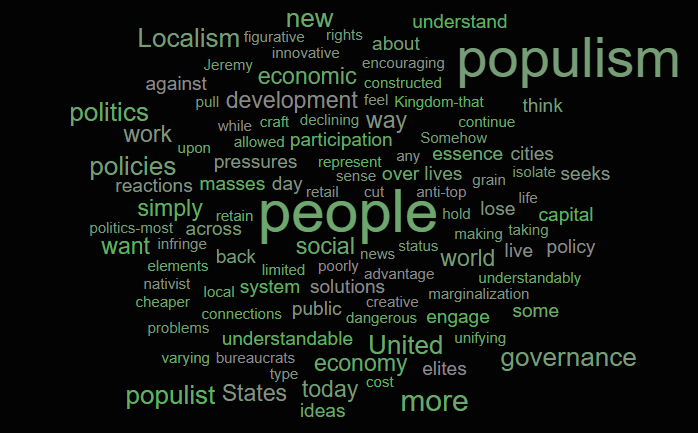
Populism has been in the news since 2016, but like any political “ism” it doesn’t have a super clear definition and meaning.  Most people, in my estimation, probably understand populism as some type of anti-elitist politics, where policies for “the people” are the focus as opposed to policies introduced by “the elites” or by “bureaucrats.” The essence of populism is an anti-top down approach to policy solutions, pushing back against an elite that tells the masses how they should live. Populism seems to be a form of governance where the people on the bottom demand their views both hold prominence and dictate the direction of public policy.


Governance by populism can be dangerous, however. It can have the feel of a mob mentality and while it can represent substantial and important concerns among the public, it can also be a driver of poorly constructed reactionary politics. It can give power and energy to groups that want policies that infringe upon the rights of others.


In The New Localism, authors Bruce Katz and Jeremy Nowak write the following about the populism we see in the United States and in the United Kingdom today:


“Populism has re-energized a politics-most prominently represented by Donald Trump in America and the Brexit coalition in the United Kingdom-that is nostalgic in focus, nationalistic in tone, and nativist in orientation. The rhetoric of this populist politics seeks to create walls, literal and figurative, that inhibit the flow of people, goods, capital, and ideas across borders; the essence of the modern economy.”


I don’t want to simply say that populism is wrong and criticize those who support populist policies. Instead I want to focus on understanding what is taking place in the brand of populism we see today, and how this cuts against the new grain of local governance and economic development we see in dynamic thriving cities in the United States (and across the globe) today.


Our populism represents a feeling of isolation and marginalization by those who do not benefit from a globalized world economy. Those who stand to lose status and lose economic means of participation feel as though they are simply being told that there is a new system in the world that doesn’t have a purpose for them. With declining social institutions and social capital in the Untied States (fewer people attending church, more people leaving rural areas, and lengthy commutes draining the life out of people) citizens see limited avenues to engage in the world in a way that feels meaningful. When work dries up or shifts from a craft to a retail job, people understandably feel threatened and vulnerable. Their intuition to pull back, isolate and protect themselves, and draw boundaries between who is and is not allowed to continue to engage in their desired economy is understandable even if it is harmful in the long run. I don’t think it is a healthy reaction, but we can understand where some of these populist pressures originate.


A new localism, in terms of governance and economic development, has to think about these pressures and reactions as it encourages a greater networking of innovative ideas, of fluid participation from varying individuals, and shifting rewards for creative and unique work. Somehow this complex system has to be made more understandable to more people, and also has to retain elements that improve the lives of people in more ways than simply making the cost of t-shirts and flashlights a bit cheaper. Localism won’t succeed and will be consumed by populist reactions if it cannot find a way to be inclusive and provide real value and a sense of meaning to “the people.”


The advantage that Localism has over traditional calcified forms of governance and over populism is its ability to cut through identity politics and focus on solutions to problems that people feel in their day to day lives. Localism aligns the efforts of the elites and the masses, encouraging development that makes cities and metro regions better places to live and work in, and helps encourage more social engagements, activities, and connections. Bringing people together and unifying interests and strengths is the only way to counter a populism which seeks to do the opposite.

Technological Change

Colin Wright reflects on his place in the world in his book Come Back Frayed, which is about his time living in the Philippines at the requests of his fans and readers. During his time outside the United States, he commented on the technology he used to document his experiences, the changes he has seen in information technology over his life time, and the uneven distribution of technology between places like the United States and the Philippines. Regarding technical change, Wright writes, “The internet revolution happened when a technology was made common, cheap, and widely available to people of the world.”


Wright focuses on the last part of his quote and highlights the fact that not everyone is operating with equal tools, “Which brings me back to the smartphone,” continued Wright, “Science fiction author William Gibson famously said, “The future is here already, it’s just not evenly distributed.” So what happens when it is?”


I really enjoy the way that Wright introduces technology, technological change, society, and social change. In the United States we tend to be so focused on our technology that we forget how much of the world goes without the basic necessities we take for granted. Much has been written and many have made better comments than I can on the inequalities that exist between countries, but Wright brings up a point not often considered. When the rest of the world is in possession of game changing technology, what will we think of the technology? How will societies react? What will it mean for political regimes in rich  countries? The United States has seen debates about how information is handled on public versus private email servers over the last two years, and currently has a president who often has a questionable use of direct social media platforms. How could these same technologies impact less developed and less wealthy countries?


Wright’s thoughts aline with a passage I recently read in a public administration class at the University of Nevada. Joseph Nye Jr. in 2002 wrote for the Brookings Institute a piece titled Information Technology and Democratic Governance and he highlighted the role of technology as an agent of social and political change. Nye wrote that social and political change often lag behind the technological change, with political change falling in behind social changes. Combining his thoughts with Wright’s, we get a sense that the large changes that seem to dominate American life, are still building toward their greater impact. Once the technology we enjoy in the United States has become more commonplace around the world, we will begin to see more social change, which will be slowly followed by political change.